FD60 vs FD20: Which FarmDroid Is Right for Your Farm?
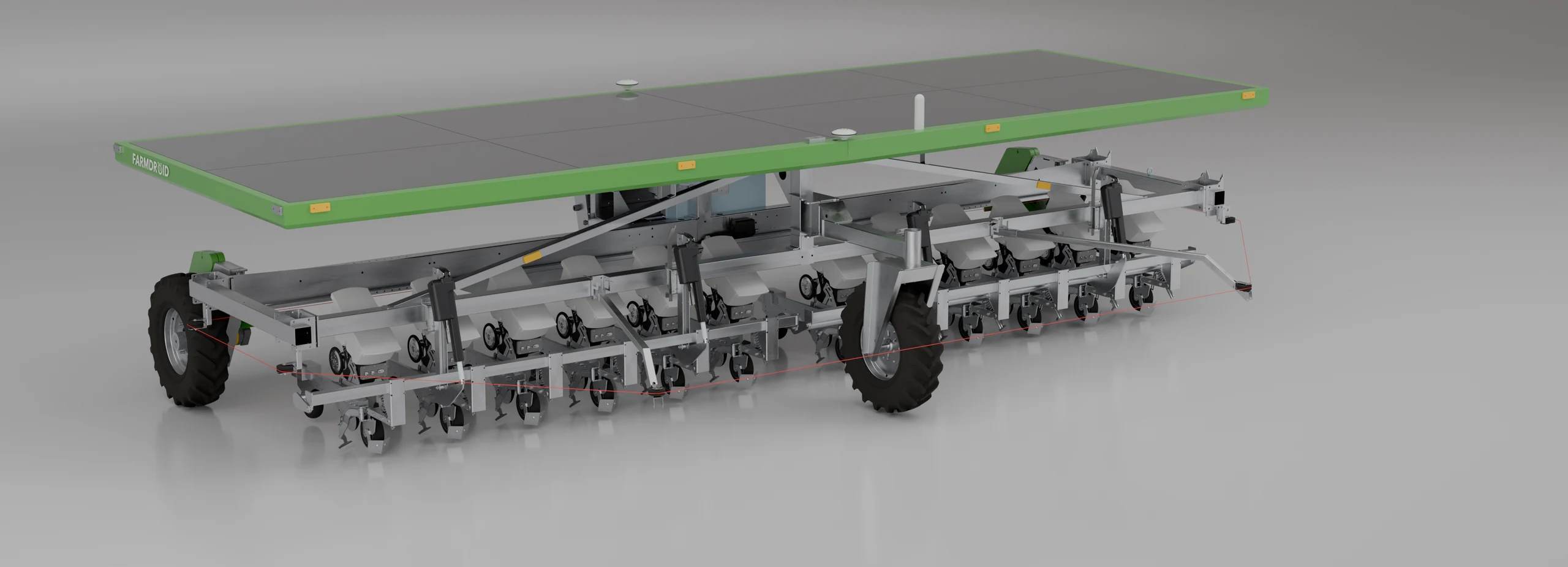
Choosing an autonomous field robot is a practical farm-planning decision. The right model depends on the area to be managed, the row configuration, available labour and how much the business is expected to expand.
The FarmDroid FD60 and FarmDroid FD20 use the same core approach: autonomous precision seeding followed by mechanical inter-row and in-row weeding. Both use RTK GPS and recorded seed positions rather than cameras or crop-recognition software. The main difference is scale. The FD60 is the higher-capacity option, while the FD20 is the smaller, more compact choice for farms that do not require the FD60’s greater working width and output.
At a glance: FD60 or FD20?
| Decision point | FarmDroid FD20 | FarmDroid FD60 |
|---|---|---|
| Overall design | Smaller, more compact autonomous field robot | Higher-capacity robot for covering more ground |
| Seasonal requirement | Suitable where the FD60’s larger capacity is not required | Minimum 60 hectares per crop per season |
| Working width | Compact configuration | Up to 6.75 metres |
| Rows per pass | Suitable for farms using a smaller row configuration | Up to 20 rows |
| Navigation | RTK GPS with recorded seed positions | 8 mm RTK GPS precision with recorded seed positions |
| Weed control | Mechanical in-row and inter-row weeding, with an optional spot sprayer available where targeted spraying is required | Mechanical in-row and inter-row weeding |
| Energy system | Confirm the current configuration for the intended specification | Solar-first operation with a Range Extender |
| Best starting point | Farms prioritising a smaller machine footprint | Farms prioritising capacity, labour reduction and future scale |
The figures above should be considered alongside field shape, bed layout, row spacing, crop programme and the number of available operating windows. A local assessment remains important before selecting either model.

How both FarmDroid models work
FarmDroid robots combine seeding and mechanical weed control in one autonomous platform. During sowing, the machine records the precise position of each seed using RTK GPS. It can then return to those recorded coordinates and remove weeds mechanically, both between crop rows and between individual plants. On the FD20, an optional spot sprayer is also available where targeted spraying is required. The FD60 described in this article uses mechanical weeding rather than this FD20-specific spot-sprayer option.
This approach is different from a camera-based autonomous field robot. The FarmDroid does not need to identify a crop visually or distinguish a plant from a weed using crop-recognition software. Instead, it knows where the crop should be because it placed the seed itself.
That provides several practical benefits:
- ✔ Mechanical weed control without relying on herbicides
- ✔ Early field entry, including before the crop has emerged
- ✔ Consistent navigation based on recorded seed positions
- ✔ Less dependence on manual hoeing during labour-intensive periods
- ✔ A clear, repeatable operating method that is easier to understand and manage
More information about the platform is available on the FarmDroid overview page, with further detail on precision sowing and mechanical weeding.
Why choose the FarmDroid FD60?
The FD60 is designed for farms that need to cover significantly more ground with one machine. It is specified for a minimum of 60 hectares per crop per season, with capacity of up to 18 hectares per day.
Its larger frame provides a working width of up to 6.75 metres, while the machine can operate with up to 20 rows in one pass. That reduces the number of runs required across a field and can help the business manage larger areas within the critical sowing and weeding windows.
The FD60 also uses 8 mm RTK GPS precision, the same fundamental navigation approach as the FD20. It records seed positions during sowing and uses those coordinates for subsequent mechanical weed control. The increase in capacity does not require a move to camera-based crop recognition.
For farms managing peak workloads, the higher capacity can reduce the number of separate machine deployments and the amount of supervision required across the season. The benefit is not simply speed; it is the ability to plan a larger area around one autonomous system.
Solar-first power with a Range Extender
The FD60 is designed for solar-first operation. Solar energy charges the battery, which powers the robot during field work. Its integrated Range Extender provides additional support when sunlight is not sufficient or when the machine is working through demanding periods.
This arrangement is intended to improve operational continuity without changing the robot’s primary solar-powered operating principle. Farmers can monitor the system and plan any required intervention around normal working routines rather than managing a conventional tractor and implement combination.
Read the official FarmDroid FD60 product information for the full manufacturer description.
Why choose the FarmDroid FD20?
The FD20 is the more compact option for farms that do not need the FD60’s larger capacity, wider working width or higher number of rows per pass.
That may make it the more suitable starting point where:
- ✔ The crop programme does not require the FD60’s minimum seasonal capacity
- ✔ Fields, beds or access routes favour a smaller machine footprint
- ✔ The farm wants autonomous seeding and mechanical weeding without moving directly to a larger platform
- ✔ Labour savings are needed, but the operation does not require the FD60’s higher daily output
- ✔ The business prefers to match investment to its current scale
The FD20 still provides the same essential operating principle: it seeds accurately, records seed positions and returns to those positions for mechanical in-row and inter-row weeding. Where targeted spraying is required, the FD20 can also be equipped with an optional spot sprayer. Farmers can review the FarmDroid FD20 information and discuss the correct configuration for their crops and fields.
The FD20 should not be viewed as an inferior version of the FD60. It is a different size of solution. Selecting a smaller machine where the capacity is appropriate can be a sensible way to control capital expenditure and avoid paying for working width that the farm may not use.
Five questions to ask before deciding
1. How many hectares must one robot manage?
Start with the area that needs to be seeded and weeded during the same season. If the farm requires the FD60’s minimum 60 hectares per crop per season and needs up to 18 hectares per day, the FD60 is the natural model to assess first.
If that level of capacity is not required, the smaller FD20 may be a better fit. The calculation should include current cropping plans as well as any land likely to be brought into production.
2. What row configuration is required?
Working width is only useful if it matches the farm’s beds, rows and tramlines. The FD60 can be configured for up to 20 rows and a working width of up to 6.75 metres, making it suitable for operations that need to cover a substantial number of rows per pass.
Before ordering, map the actual row arrangements rather than relying only on total hectares. Two farms with the same cropped area may have very different requirements because of field layout and row configuration.
3. How much labour must be released?
Both machines are intended to automate two time-consuming operations: precision seeding and mechanical weed control. The FD60’s greater capacity may be valuable where labour pressure is most severe during short seasonal windows or where a larger area must be maintained with a limited workforce.
The FD20 can be appropriate where the main objective is to automate these operations on a smaller scale. The decision should consider not only the number of people currently employed, but also recruitment difficulty, overtime, contractor availability and the cost of delaying field work.
4. Is the farm likely to expand?
A machine should be assessed against the farm’s likely requirements over its working life, not only this year’s acreage. Expansion may come from additional land, new crop areas or a decision to bring more weeding work in-house.
The FD60 may provide more capacity for planned growth. The FD20 may be appropriate when the business wants a compact starting point and has no immediate requirement for the FD60’s larger footprint. A discussion with the distributor can help compare today’s requirements with a realistic expansion plan.
5. What support is available locally?
Autonomous equipment should be assessed as a complete operating solution, including setup, field mapping, training and service support. AGRI-DROID UK LTD works with farmers to understand their crops, row layouts and practical operating requirements before recommending a configuration.
Farmers can also review the FarmDroid specifications and data sheet before arranging a conversation.
FD60 vs FD20: the practical conclusion
The choice is not about identifying one universally better FarmDroid. It is about matching capacity and machine configuration to the farm’s operating plan.
Choose the FD60 when the business needs:
- ✔ A minimum capacity of 60 hectares per crop per season
- ✔ Up to 18 hectares of daily output
- ✔ Up to 6.75 metres of working width
- ✔ Up to 20 rows in one pass
- ✔ Solar-first operation supported by an integrated Range Extender
- ✔ Greater capacity for labour reduction and future expansion
Consider the FD20 when the business needs a smaller, more compact autonomous field robot and does not require the FD60’s larger capacity or working width. Its suitability should be confirmed against the farm’s specific row configuration, crop programme and labour objectives.
For commercial farmers and agricultural businesses in Shropshire, Staffordshire, the West Midlands, Worcestershire, Herefordshire, Powys, Clwyd and Cheshire, AGRI-DROID UK LTD can help assess the practical fit. Contact us to discuss your acreage, row layout, labour requirements and plans for expansion before choosing between the FD60 and FD20.